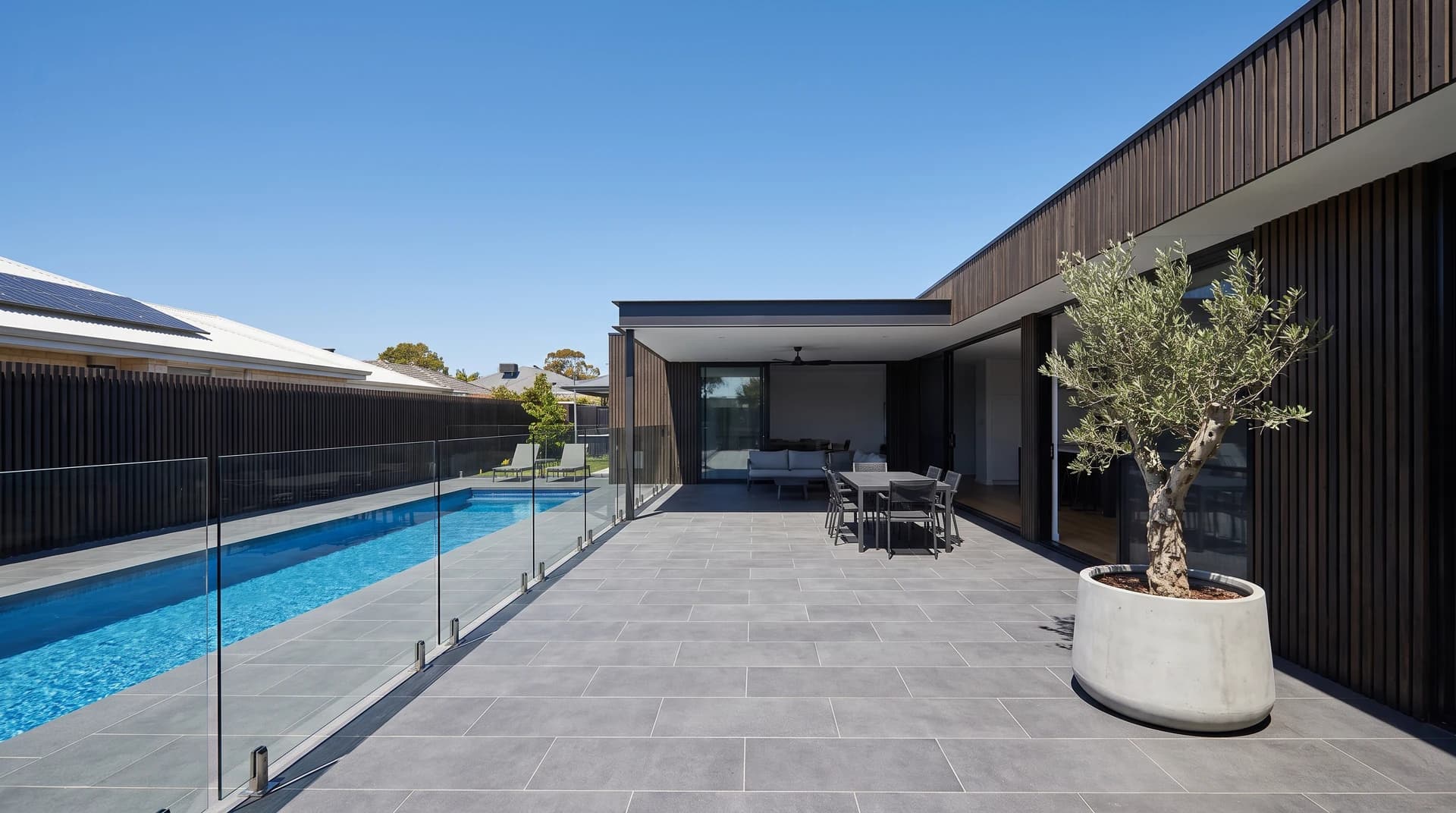
Porcelain paving Perth
Porcelain paving is the low maintenance choice in Perth, and the only surface we lay that never needs sealing. It absorbs next to no water, so it doesn't stain, doesn't go green in a shaded return, and shrugs off whatever gets spilled on it.
- Near zero absorption, never needs sealing
- Slurry primed so it bonds properly
- 20mm outdoor pavers, not indoor tile
Get a price for porcelain paving
A photo of the area and a rough size is enough to price it.
Twenty millimetre outdoor porcelain, laid wet
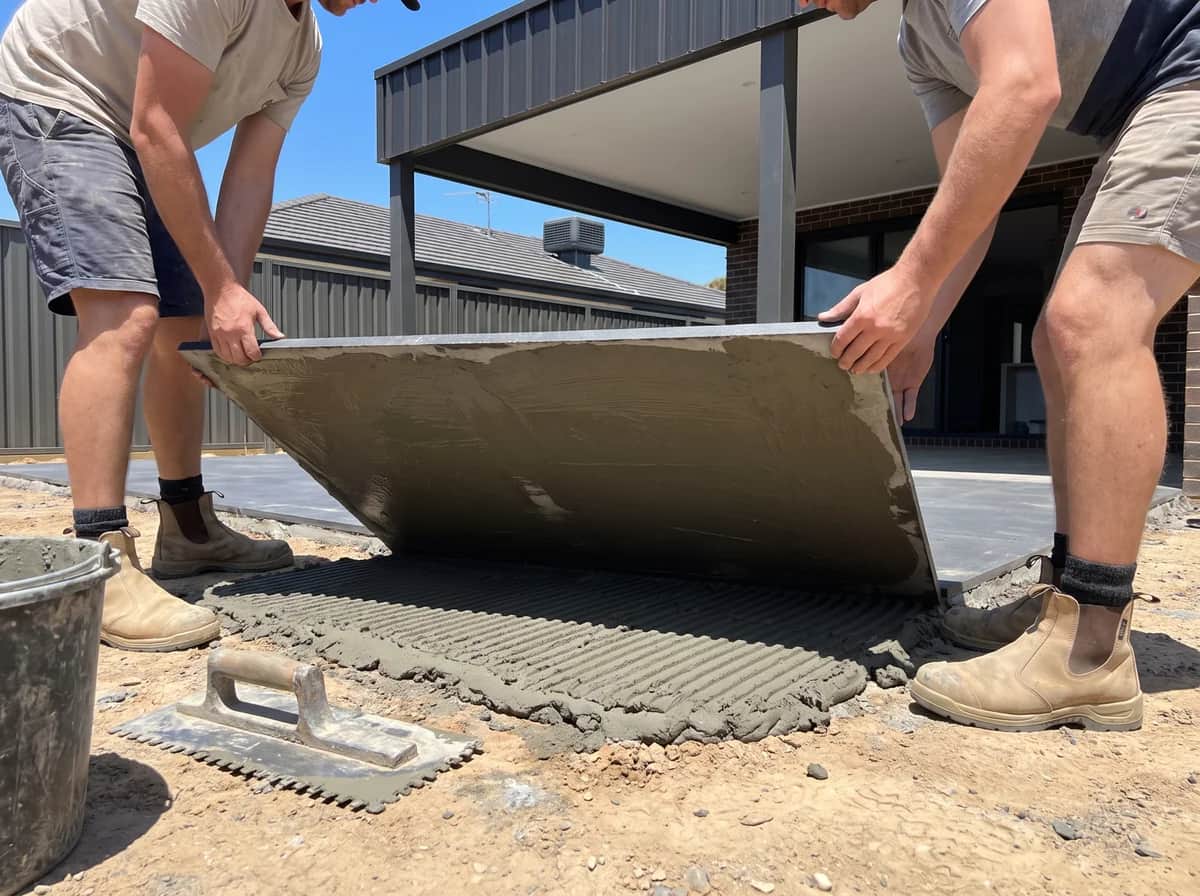
Outdoor porcelain is a 20mm paver, roughly twice the thickness of an indoor tile, made to take weight and weather. Anything thinner belongs on a floor inside, so we'll always check the thickness of a range you've been shown.
It's manufactured rather than quarried, so every piece is the same size to within a fraction of a millimetre. That's what lets us lay it to a narrow, even joint, and a 3mm to 5mm joint running dead straight across a surround is a big part of why porcelain looks the way it does.
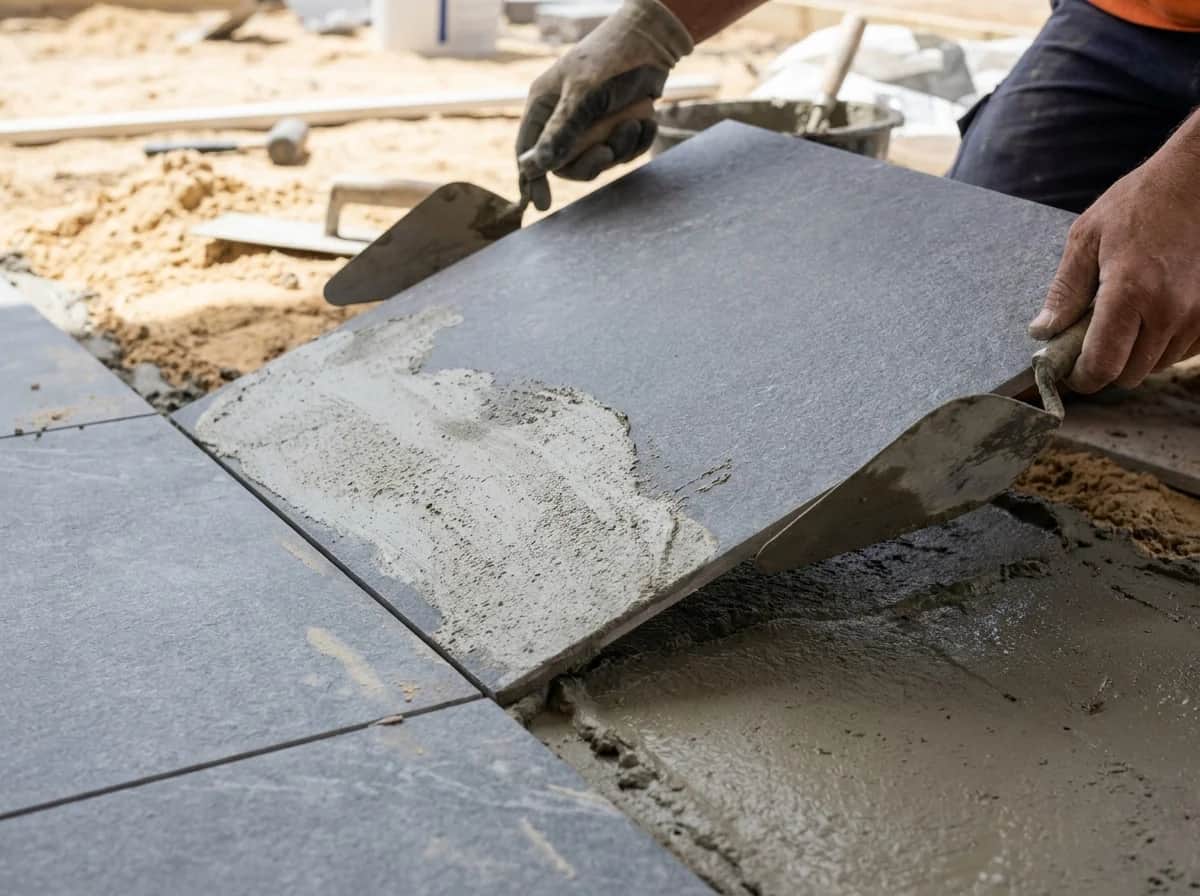
We lay it wet on a full mortar bed with a primer on the underside of every paver, cut it on a wet saw, and grout the joints. No sealing, then or later.
What porcelain is for
It solves a particular set of problems very well. Here's where we'd put it first.
Anywhere that stains
An alfresco with an outdoor kitchen, a barbecue, a wine glass and children. Porcelain absorbs effectively nothing, so red wine, sunscreen, oil and leaf tannin sit on the surface and wipe straight off.
Shaded, damp returns
The narrow south side of a Perth house that never sees the sun is where porous stone goes green every winter. Porcelain stays clear, because there's nothing for algae to get into.
Inside to outside, on one level
Where an indoor tile has a matching outdoor porcelain in the same range, the floor runs through the door with no visual break at all. Nothing else we lay can do that, and on a modern Perth alfresco it's often the whole reason for choosing it.
Go pale around a pool
Dark charcoal porcelain gets hot underfoot in full Perth summer sun. It's entirely a colour question, so a pale porcelain around a pool gives you all the same benefits and stays comfortable.
Why porcelain takes more laying, not less
People assume the perfectly consistent material is the easy one, and it's the other way round. When every paver is identically sized, the setout has to be exact, because there's no natural variation to absorb anything.
It also bonds differently to stone. Porcelain absorbs effectively nothing, which is exactly why it doesn't stain, and it means a plain mortar bed has nothing to grab onto. So every paver gets a slurry primer on its underside and a bed mixed to suit, which is what makes the bond hold for good.
And it cuts slowly. Every cut is a wet saw cut, so a curved pool surround in large format porcelain is a lot of careful work. The material that asks nothing of you afterwards asks the most on the day.
What moves a porcelain price
With porcelain the paver itself moves the number more than the laying does, because the range between the cheapest and the dearest outdoor porcelain is wider than for any stone we lay.
The paver
A plain mid grey 600 by 600 is inexpensive. A 1200 by 600 stone-look panel from a range with a matching indoor tile can cost several times that. Same laying, very different supply cost.
Paver size
Large format is a two person lift on every piece and slower to set and level, so the size that looks best usually takes the longest to lay.
Priming and wet cutting
Every paver gets a slurry primer on its underside so the bond holds, and every cut is a wet saw cut because porcelain can't be split. Both take time and both are part of doing it properly.
Running inside to outside
Matching an indoor tile out through a door means planning the levels and the threshold to a tighter tolerance, and it's worth the extra care because of how it looks when it's done.
Looking after porcelain
Porcelain asks almost nothing of you once it's down. That's the point of it. Five things worth knowing anyway.
- There's no sealing to do, ever. Water absorption is effectively zero, so there's nothing to soak in and nothing to seal against.
- Wash it with warm water and any general cleaner. Nothing about porcelain is fussy, and even a pressure washer won't hurt it.
- Look after the grout rather than the paver. The joint is the only absorbent part, so a good epoxy or modified grout at laying is what keeps the surface easy.
- Check the slip rating before you order. A polished finish that's lovely in an alfresco is a different proposition on a wet pool edge, and we'll look it up with you.
- Choose 20mm for anything outside. It's the standard outdoor thickness and it's what we lay, so if a range only comes in 9mm or 10mm, that's the indoor version.
Frequently asked questions about porcelain paving
The other materials we lay
Crazy paving
Cut and fitted on site, piece to piece. The surface for a freeform pool or an awkward courtyard.
Travertine paving
The default Perth pool stone. Cool underfoot, grippy wet, and sealed before we leave.
Limestone paving
Pale, local and soft. At its best against a limestone wall or under an alfresco.
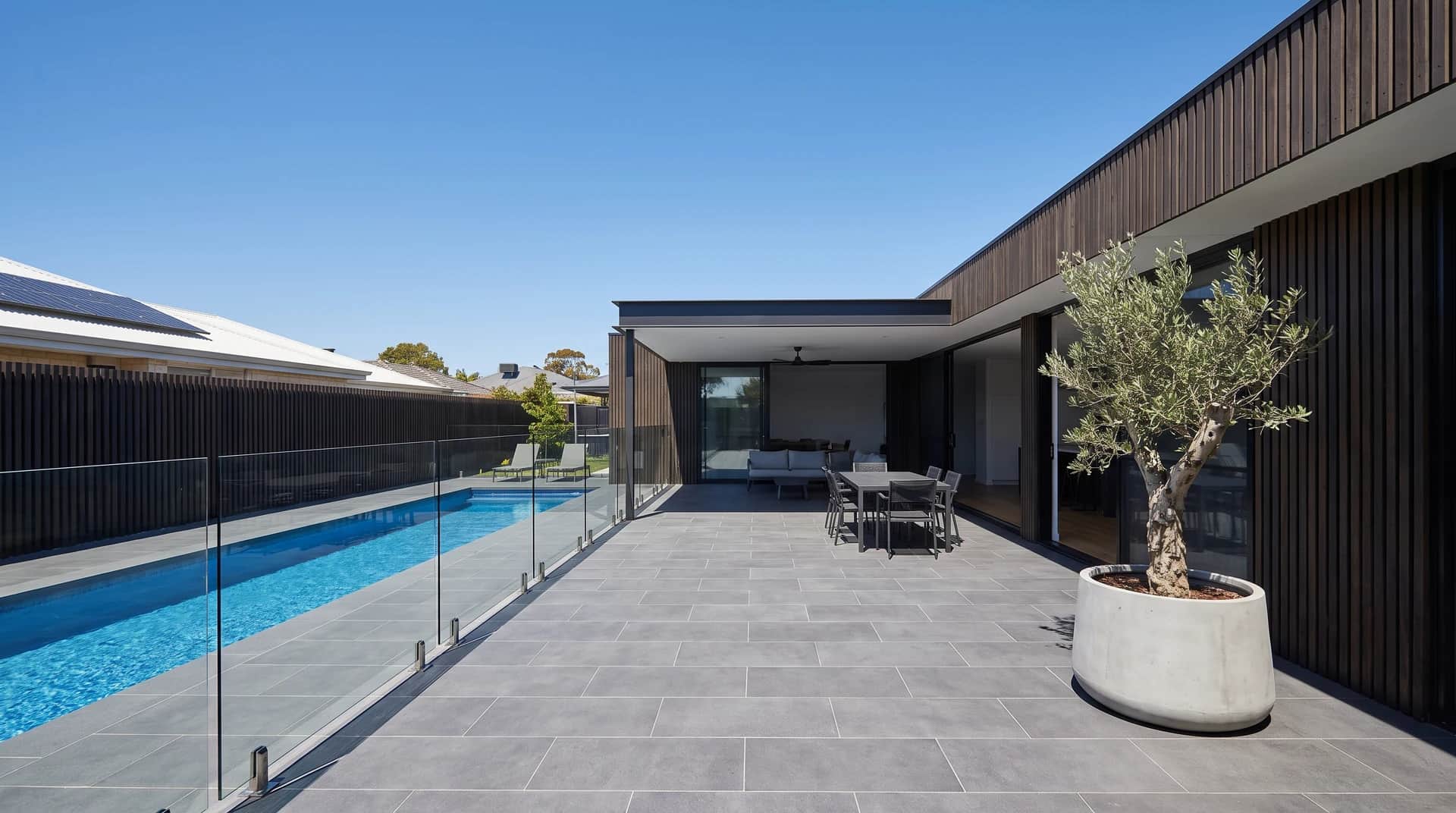
Send us the area and we will price it in porcelain paving
A photo of the area and a rough size is enough. If we think another material would serve you better we will say so, and say why.